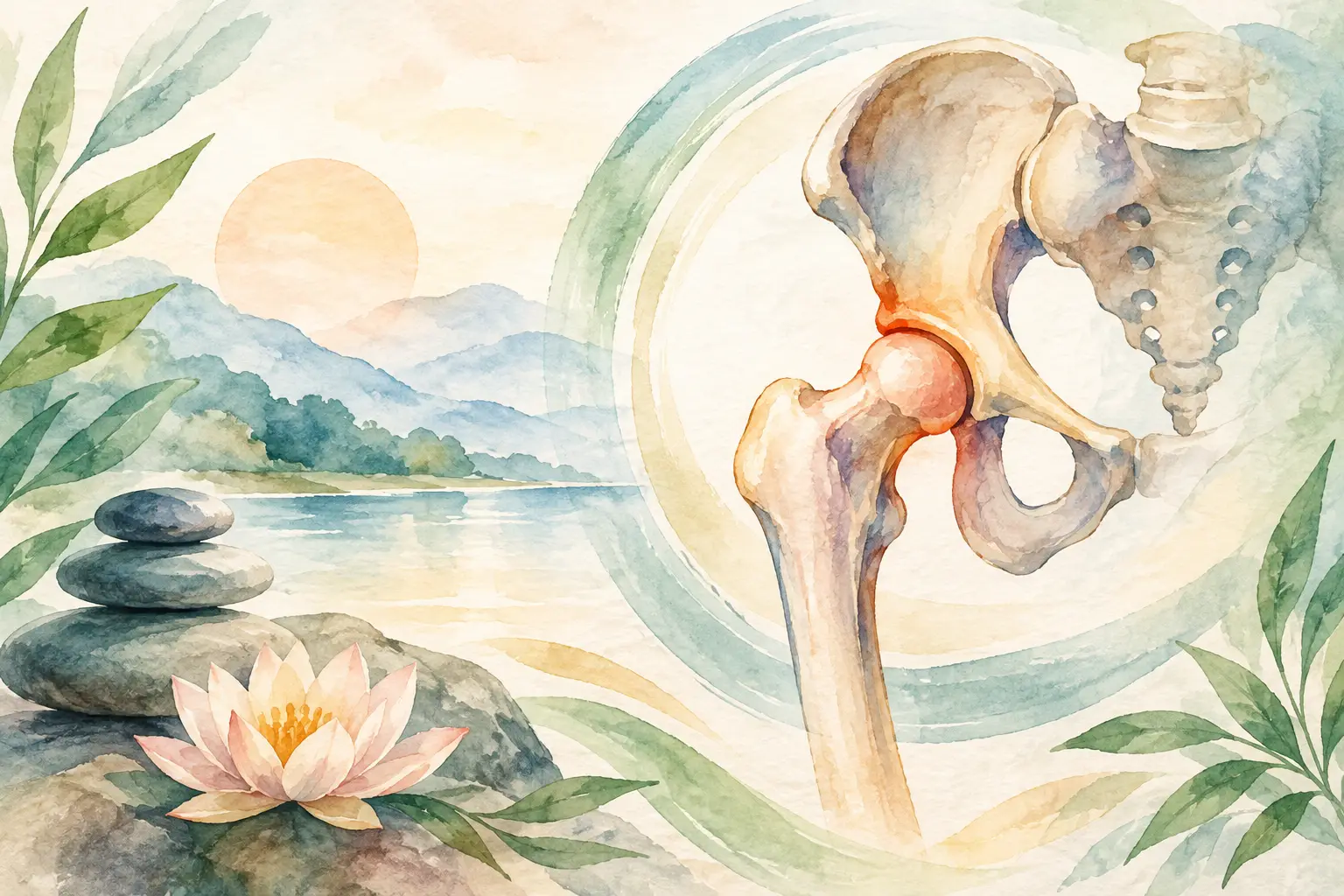
A hip that will not comfortably turn, bend or bear weight can make ordinary life feel unexpectedly narrow. You may notice it when getting out of a low chair, crossing your legs, walking uphill, cycling to work, or trying to settle into a yoga pose that once felt simple. Osteopathy for restricted hip mobility looks beyond the hip alone, considering how the pelvis, lower back, legs, breathing and nervous system may be contributing to the restriction.
The aim is not to force range of motion. A useful hip is not simply a flexible hip. It is a hip that can move with enough comfort, control and confidence for the life you want to live.
Why hip mobility becomes restricted
The hip is a deep ball-and-socket joint designed for both mobility and stability. Its movement is shaped by the joint itself, the surrounding muscles and connective tissue, the position of the pelvis, and how the nervous system interprets load and threat. Restriction can therefore have many sources, and it is not always a sign that something is “tight”.
Sometimes the change follows an obvious event, such as a fall, a long period of reduced activity, surgery, pregnancy, a new training routine or repetitive sitting. At other times it develops gradually. Long days at a desk, stress that keeps the body braced, an old ankle injury, persistent low-back discomfort or a change in walking pattern can all alter how the hip is used.
Pain can also make the body protective. Muscles around the hip may become more guarded, not because they need aggressive stretching, but because the system has learned that a particular movement feels unsafe or irritating. In this situation, pushing harder into the range can increase sensitivity rather than restore ease.
For people with hypermobility, the experience can be different again. The hip may appear to have plenty of range, yet feel unstable, painful or difficult to control. Here, the priority is often not gaining more movement but building proprioception, strength and a clearer sense of support.
What osteopathy for restricted hip mobility involves
Osteopathic care begins with a conversation and an attentive assessment. Your practitioner will ask when the restriction began, which movements are difficult, how symptoms behave through the day, and whether sleep, stress, fatigue or previous injury are part of the picture. They may observe walking, standing, sitting, balance and simple hip movements, while also considering the lower back, pelvis, knees, feet and ribcage.
This wider view matters. A hip that feels blocked during a squat may be responding to limited ankle movement, a pelvis that struggles to transfer load, or a lower back that is doing too much work. Equally, hip pain can sometimes be referred from the lumbar spine or arise alongside other medical conditions. Assessment helps distinguish patterns rather than assuming every hip problem has the same cause.
Hands-on treatment may be used to reduce discomfort, improve the quality of movement and help the body settle. Depending on your presentation, this can include gentle joint articulation, soft-tissue techniques and work with the surrounding pelvis, lower back or legs. Treatment is adapted to your comfort, sensitivity and goals. It should not feel like a test of endurance.
At ZOLO, manual therapy is paired with movement re-education rather than treated as a stand-alone fix. The treatment table can create a useful pause, but lasting change is often supported by how you stand, walk, breathe, rest and move between appointments.
Movement that teaches the hip to trust again
A restricted hip often benefits from calm, precise movement rather than a catalogue of stretches. The right exercise depends on whether the hip is stiff, irritable, unstable, recovering from injury or simply underused. There is no universally correct hip-opening routine.
Early movement may be small and supported: gentle weight shifts, pelvic awareness, controlled hip rotation within a comfortable range, or noticing how the foot meets the floor. These movements can improve proprioception – the body’s sense of position and effort – without provoking a protective response.
As comfort improves, the work may progress towards functional tasks. This could mean learning to hinge for a squat, stepping with better control, building single-leg stability, or finding a more balanced relationship between the hip and lower back during walking. Strengthening is often part of the process, especially when restriction has led to avoidance or when the hip feels unreliable.
Breath also has a place here. Holding the breath and gripping through the abdomen, buttocks or jaw can be a sign that the body is working harder than necessary. A slower exhale and a less effortful approach can help some people reduce unnecessary tension while moving. This is not about making pain disappear through relaxation. It is about giving the nervous system more information that movement can be manageable.
When stretching helps – and when it does not
Stretching can feel relieving when muscles are genuinely stiff after sitting, training or reduced activity. It may be one useful part of a plan. But if a stretch produces pinching at the front of the hip, sharp pain in the groin, lingering soreness, numbness or a sense of instability, more stretching is unlikely to be the answer.
For a hypermobile person, repeatedly stretching into end range can sometimes reinforce instability. For someone with an irritated hip joint, forcing deep flexion or rotation may aggravate symptoms. In both cases, a smaller range with steadier control is often more productive. The question is not, “How far can I go?” but, “Can I move here with ease and support?”
The role of posture, load and recovery
There is no single perfect posture that protects every hip. Bodies need variation. Yet spending many hours in one position can make any area feel less responsive, particularly when work, study or travelling leave little space for movement.
Small changes can be meaningful: standing up between focused tasks, varying how you sit, taking a short walk, or choosing a gentler route home when the hip is flared. The goal is not to monitor every posture, but to restore options. A body that has more ways to move is often less likely to rely on one guarded pattern.
Load matters too. A sudden increase in running, hill walking, strength training or even weekend gardening can exceed what the hip currently tolerates. Reducing activity completely may be necessary for a short period after an acute flare, but prolonged avoidance can lead to further loss of confidence and capacity. A paced return, with enough recovery between sessions, is usually more sustainable.
For people living with burnout, ME/CFS or chronic fatigue, hip rehabilitation needs particular care. Progression should respect energy limits and post-exertional symptom changes. A movement programme that is technically sound but exhausts the whole system is not the right programme. Gentle consistency, rest and clear pacing may matter more than intensity.
When to seek medical assessment promptly
Osteopathic assessment can be helpful for many non-urgent hip concerns, but some symptoms need timely medical evaluation. Seek urgent advice after a significant fall or accident, if you cannot bear weight, or if the hip is suddenly hot, swollen or severely painful. New numbness, weakness, loss of bladder or bowel control, fever, unexplained weight loss, or pain that is severe and unrelenting also warrant medical attention.
Persistent groin pain, night pain, marked loss of movement or symptoms that are worsening despite sensible self-care deserve assessment as well. Osteopathic care works best as part of responsible, collaborative healthcare, including referral when that is the safest next step.
A more spacious way back to movement
Restricted hip mobility can be frustrating because it appears in so many ordinary moments. Yet the way forward does not have to be forceful. With individual assessment, gentle hands-on support, appropriate movement and a pace that respects your nervous system, the hip can begin to feel less guarded and more available.
Let progress be measured in lived details: walking without planning every step, sitting through a meeting more comfortably, returning to the stairs with confidence, or moving on the mat with a little more room to breathe. These are quiet changes, but they are often where restoration begins.