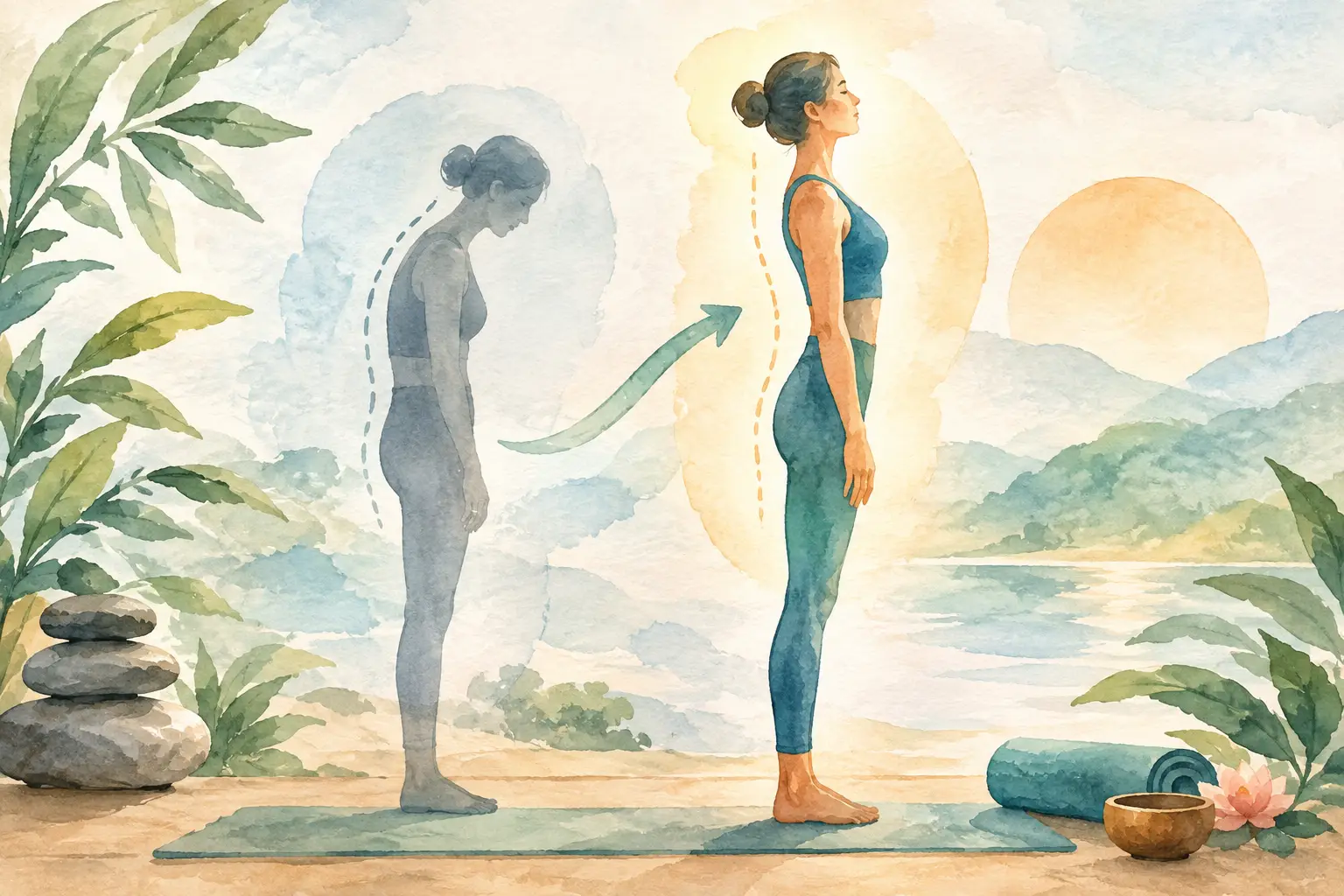
The familiar afternoon collapse at a desk, the neck that tightens on the cycle home, the low back that feels tired before the day is done – these experiences are rarely solved by being told to simply “sit up straight”. Movement re-education for poor posture takes a more useful and compassionate view. It explores how you habitually organise your body, breathe, respond to stress and move through ordinary life, then helps you find options that feel more supported and less effortful.
Posture is not a pose to hold. It is a living response to your environment, workload, energy, attention and history. A body that has been still for hours may need movement, not stricter discipline. A body living with pain, hypermobility, burnout or fatigue may need gentler pacing before it needs more strength. The aim is not perfection. It is greater ease, adaptability and trust in your own movement.
Poor posture is not a personal failure
Images of an ideal upright posture can be misleading. There is no single position that prevents all pain, and many people with rounded shoulders or a forward head have no symptoms at all. Equally, someone who appears beautifully aligned can still experience headaches, back pain or restricted breathing.
What matters clinically is not whether your body matches a diagram. It is whether certain positions or movement patterns are becoming costly. Perhaps your upper back becomes rigid while you concentrate. Perhaps you brace your abdomen all day, lift your shoulders when breathing, or lock your knees when standing. These strategies often begin as sensible adaptations: to a demanding screen-based job, an old injury, anxiety, insufficient sleep, or a body that does not feel stable. Over time, however, they can reduce variation and make everyday tasks feel heavier.
A posture can become problematic when it is the only posture available. The most supportive position is often the next one: a small shift in your chair, a brief walk, a change in visual focus, or a fuller exhale before you move again.
What movement re-education for poor posture involves
Movement re-education is a guided process of noticing and practising. It combines assessment with small, meaningful experiments, rather than prescribing a universal set of corrective exercises. In osteopathic care, this may sit alongside hands-on treatment to reduce discomfort or improve mobility, making it easier to sense and use new movement options.
The work commonly begins with everyday activities: sitting at a laptop, standing in a queue, turning to reverse a car, reaching for a shelf, walking between meetings, or getting up from bed. Your practitioner observes not only range of motion, but also effort, timing, breath and confidence. You may discover, for example, that your neck works hard because your ribcage is stiff, or that your low back braces because your hips do not feel secure.
The next step is not to force a correction. It is to create a clear, manageable alternative. This might mean learning to let the ribs move during breathing, sensing both feet before standing, allowing the shoulder blades to glide as you reach, or using your hips more freely when bending. Repetition matters, but so does attention. A few slow, well-felt movements can be more valuable than many hurried repetitions.
Awareness comes before correction
Proprioception is your sense of where your body is and how it is moving. When discomfort, stress or long periods of immobility have dulled this sense, people often try to compensate by holding themselves tightly. Yet extra tension can make movement less precise.
Gentle awareness practices can restore useful information. You might notice the pressure beneath your feet, the contact between your back and the chair, or whether one side of your chest expands less easily. This is not about monitoring yourself all day. It is about learning the difference between support and strain, so you can respond sooner and with less force.
Mobility and stability need each other
Restricted areas may need mobility, while overworked or unstable areas may need better control. The balance differs from person to person. Someone who spends long hours at a desk may benefit from thoracic movement, hip mobility and regular changes of position. Someone with hypermobility may already have plenty of range and instead need slow, low-load work that builds coordination, joint awareness and confidence without pushing into end range.
For this reason, a generic posture routine is not always helpful. Aggressive stretching can irritate sensitive joints. Intense strengthening may be too much during burnout, ME/CFS or a period of significant fatigue. A paced approach respects the nervous system as well as the muscles and joints. Progress may be measured in smaller signals: less bracing, easier walking, fewer flare-ups, or more energy left at the end of the day.
The role of breath and the nervous system
Breathing is part of posture, not an optional extra. When the nervous system is under pressure, the breath often becomes shallow or held. The ribs move less, the jaw and shoulders may tense, and the body can remain prepared for action even while sitting still. This can make a familiar working posture feel much more uncomfortable.
Breath awareness is not about taking exaggerated deep breaths or forcing relaxation. It is often quieter than that: noticing whether you can exhale without collapsing, allowing the lower ribs to widen, or pausing long enough to feel the ground before a difficult task. These small moments can reduce unnecessary muscular effort and make movement feel safer.
This matters particularly when pain has been present for a long time. Pain is real, but it is influenced by many factors including tissue sensitivity, sleep, stress, previous experiences and fear of movement. Movement re-education does not claim that all pain is caused by posture. Instead, it offers practical ways to rebuild capacity without treating the body as something that has gone wrong.
Bringing change into a working day
The best programme is one that fits the life you actually lead. A researcher absorbed in data, a student revising for exams, and a professional moving between meetings may all need different strategies. An expensive chair or standing desk can be useful, but equipment cannot replace regular variation and body awareness.
Rather than setting rigid rules, choose a few gentle cues connected to moments already in your day. When you fill a kettle, feel both feet. Before opening your laptop, take one unhurried breath and let your shoulders settle. After a video call, stand and let your arms swing for a minute. When walking, notice whether your gaze is fixed downwards or whether you can allow the head and chest to move naturally with your stride.
These are not productivity hacks. They are small invitations to return to your body before tension becomes the default. If a cue makes you feel more guarded or self-critical, it is not the right cue for now. The practice should create more choice, not another demand.
When individual guidance is worthwhile
Self-directed movement can be a good starting point when symptoms are mild and you feel safe experimenting. Individual assessment is particularly valuable when pain is recurring, movement feels fearful, symptoms travel into an arm or leg, dizziness is present, or you are living with hypermobility, fatigue or a complex health history.
A thoughtful practitioner can distinguish between a habit that needs gentle retraining and a symptom that needs further medical assessment. They can also adapt the pace to your capacity. At ZOLO, movement education is approached as part of whole-person osteopathic care, with attention to structure, breath, nervous-system regulation and the realities of daily life.
If you notice new weakness, loss of coordination, changes in bladder or bowel control, unexplained weight loss, fever, or severe pain following significant trauma, seek urgent medical advice rather than relying on posture work alone.
Your body does not need to be held in a perfect shape to be well supported. It needs enough safety, strength, mobility and attention to keep responding to life. Begin with one small movement you can feel, repeat it kindly, and let steadiness grow from there.